
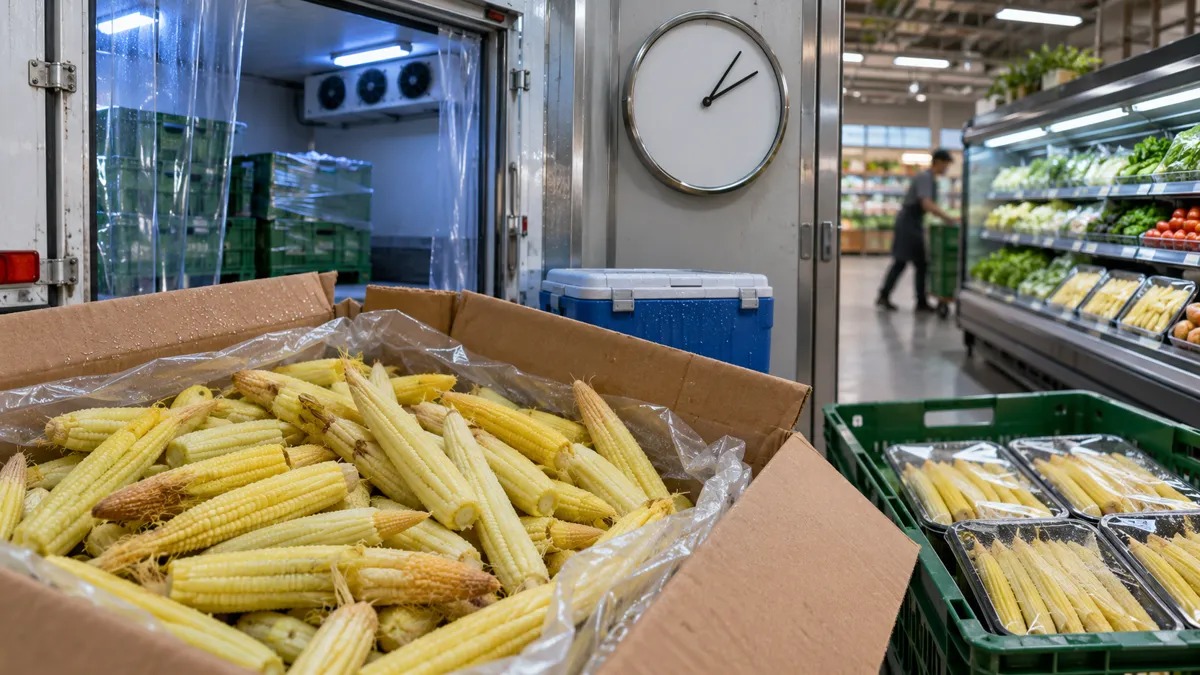

Baby corn that looks good at dispatch may still leave a supermarket with too little time to sell it. When assessing a baby corn exporter for supermarkets, focus on the condition and usable life expected at your own receiving point. That shifts the discussion from an attractive sample to a supply arrangement that fits the store’s delivery schedule and rate of sales.
Table of Contents
Define the Product That Will Reach the Shelf
Agree whether the order is for retail packs or bulk product that needs further handling after arrival. For retail packs, consider the weight customers are likely to buy and how the pack will sit in the display. A format that suits a supplier’s packing line may still create extra work or unnecessary waste in your stores.
Describe the physical quality in terms that both parties can inspect. Specify the required cob size range, trimming and acceptable variation, with photographs where they help. Discuss how broken tips, discolouration or other visible defects will be assessed, rather than leaving the decision to a broad description such as premium quality.
Keep appearance and food safety checks separate. An attractive sample cannot establish the controls used during growing, handling and packing. Ask the technical team to review the evidence appropriate to the destination market and the retailer’s requirements, including how a delivered lot can be traced back if a problem is identified.
Count the Full Journey Before Allocating Shelf Life
Clarify when any quoted shelf life begins. Harvest, packing, dispatch and receipt are different points in the journey. A statement that does not identify its starting point or storage conditions is difficult to use when planning distribution and display.
Map the expected time from packing through transport, clearance and delivery to the distribution centre, then allow for the journey to individual stores. The remaining selling period needs to fit normal sales, not just a promotional forecast. A short delay can matter more to a low-volume store than to one that sells the same quantity in a day.
Agree a minimum acceptable remaining life at a defined handover point, supported by evidence for the actual product and pack. The conditions used to establish that life should be clear. Avoid assuming that a result achieved under controlled storage will automatically apply after a different transport route or additional handling.
Trial the Route and Pack Together
Use an initial commercial shipment to assess the proposed process. A separately couriered sample can help agree appearance, but it may not experience the same delays or handling as the regular order. Record the time and condition at receipt, and retain representative packs for checks through the intended selling period.
Assess how the packaging performs as well as the corn itself. Look for damage, moisture build-up and labels that become difficult to read. Any change to the pack or handling conditions should be reviewed by the technical team, since a neat presentation alone does not establish that it preserves the product effectively.
Match Replenishment to Actual Sales
Compare the cost of frequent smaller deliveries with the cost of holding more stock. A lower price per kilogram can lose its advantage if stores need repeated markdowns or dispose of unsold packs. Use sell-through and rejection information from the trial to set realistic order quantities, then review them as demand becomes clearer.
The quality plan should also cover handovers between businesses. Maintaining suitable conditions throughout produce transport depends on loading, airflow and handling as well as the vehicle’s refrigeration. Establish who reviews transport records and who responds if a shipment arrives outside the agreed specification.
A reliable buying decision rests on what reaches the shelf in saleable condition. Combine a clear specification with evidence from the actual route, an agreed remaining-life requirement and orders that reflect store demand. That gives the retailer a more useful measure of value than dispatch appearance or the lowest quoted unit price alone.
